


NEWS & INSIGHTS
Chemical Industry Updates & Company News
What Are Quaternary Ammonium Compounds? Key Properties, Safety Profiles, and Regulatory Limits for Disinfectant Formulators
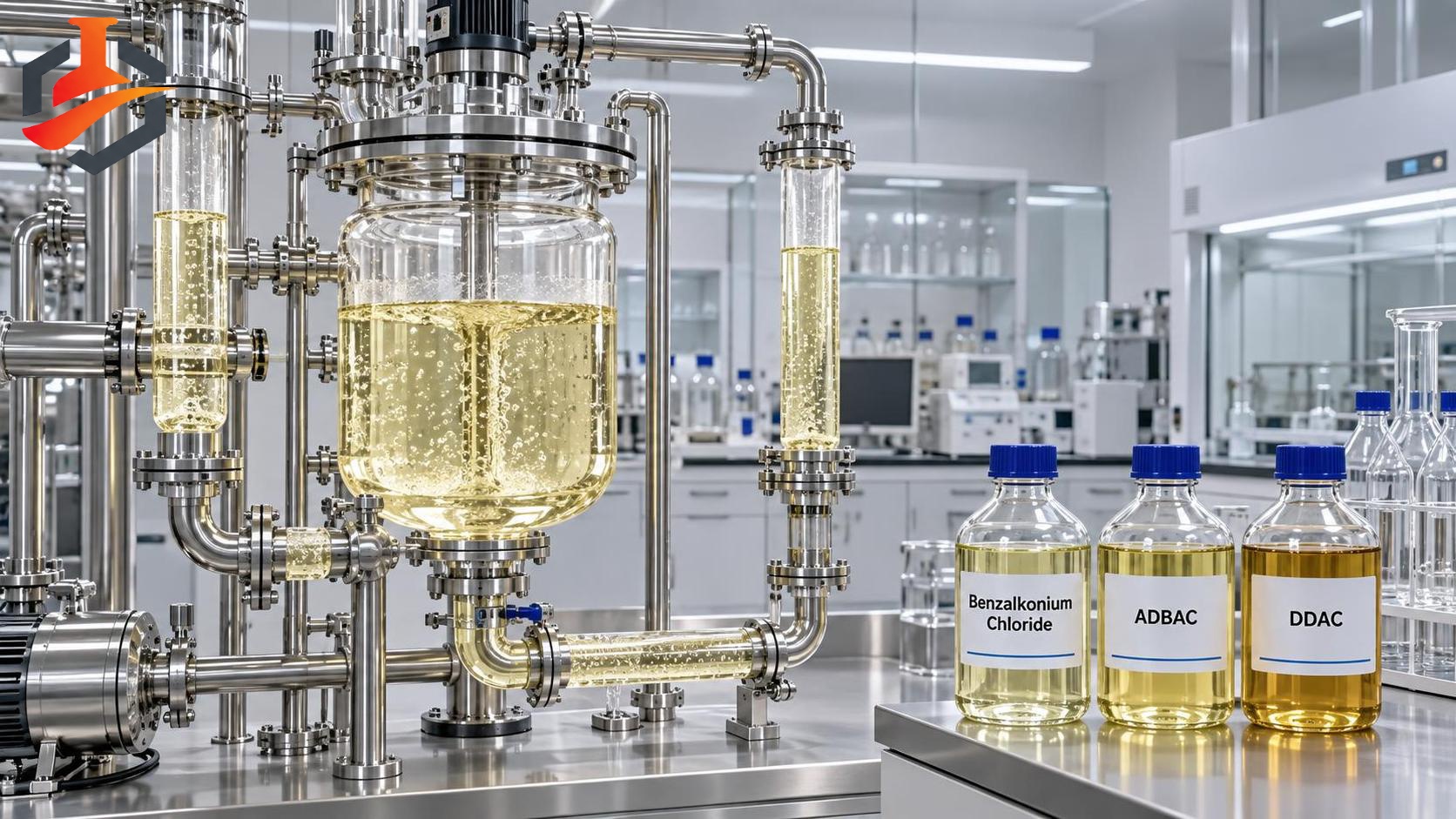
Quaternary Ammonium Compounds—often shortened to QACs—are among the most quietly influential molecules in modern disinfection. You won’t find them on consumer labels with fanfare, but they’re almost certainly present in the hospital-grade wipe you used before a procedure, the surface spray in your office breakroom, or the stable, low-foaming cleaner in a pharmaceutical cleanroom. For technical evaluators working at formulation labs, regulatory affairs teams, or raw material sourcing desks, QACs aren’t just another ingredient—they’re a balancing act between efficacy, compatibility, safety, and compliance.
What makes them so persistent in disinfectant portfolios? Not flashiness. Not novelty. It’s their reliable, predictable behavior: strong cationic charge, consistent biocidal action across Gram-positive and Gram-negative bacteria (and some enveloped viruses), thermal resilience, and formulation versatility. But that reliability comes with quiet trade-offs—subtle solubility quirks, variable degradation pathways, and evolving regulatory scrutiny. Understanding QACs isn’t about memorizing chemical names; it’s about recognizing how their molecular architecture shapes real-world performance—and where assumptions can quietly derail a product launch.
More Than Just “Cationic Surfactants”
The term “quaternary ammonium compound” describes a structural class—not a single substance. At its core sits a nitrogen atom covalently bonded to four organic substituents and carrying a permanent positive charge, independent of pH. That fixed charge is why QACs bind so readily to negatively charged microbial membranes, disrupting lipid bilayers and causing leakage of cellular contents. But the *nature* of those four substituents determines everything else: water solubility, critical micelle concentration (CMC), foaming tendency, protein interaction, and even environmental half-life.
Common examples include benzalkonium chloride (BAC), alkyl dimethyl benzyl ammonium chloride (ADBAC), didecyldimethylammonium chloride (DDAC), and alkyldimethyl ethylbenzyl ammonium chloride (ADEBC). Each carries distinct hydrophobic tail lengths and aromatic or aliphatic configurations—meaning two QACs with identical active concentrations may behave very differently in a high-hardness water matrix or alongside anionic thickeners. A formulator might choose DDAC for enhanced sporicidal synergy in a ready-to-use hospital disinfectant, while opting for a shorter-chain ADBAC variant for faster rinse-off in food-contact applications.
Stability ≠ Inertness
QACs are prized for thermal and shelf-life stability—many remain effective for 24+ months in sealed containers under ambient conditions. Yet this stability becomes a double-edged sword when considering environmental fate. Unlike hydrogen peroxide or hypochlorite, which rapidly decompose into benign byproducts, QACs resist hydrolysis and photolysis. Studies show certain alkyl chain variants persist in wastewater treatment plants, adsorb strongly to sludge, and accumulate in aquatic sediments. Their chronic ecotoxicity—particularly to algae and crustaceans—is now under sharper regulatory focus, especially in the EU.
Dermal and ocular irritation profiles also vary meaningfully. While generally lower in acute toxicity than chlorine-based agents, QACs can cause cumulative skin sensitization—especially with repeated occupational exposure. BAC, for instance, has well-documented potential to disrupt skin barrier lipids over time. Formulators evaluating alternatives shouldn’t just compare LD50 values; they should assess exposure duration, vehicle effects (e.g., ethanol co-solvents increasing skin penetration), and whether preservative systems might interact synergistically—or antagonistically—with the QAC’s mode of action.
Regulatory Limits: Not Just Numbers on a Dossier
Global regulatory frameworks treat QACs not as a monolith—but as families requiring individual assessment. The U.S. EPA’s Antimicrobials Division mandates specific data packages for each QAC active ingredient, including mammalian toxicology, environmental fate modeling, and efficacy against standardized test organisms. Under the Pesticide Registration Improvement Act (PRIA), re-registration timelines often hinge on updated endocrine disruption screening data—a growing requirement for longer-chain alkyl variants.
In the EU, ECHA’s Biocidal Products Regulation (BPR) classifies many QACs under Product Type 2 (disinfectants and algaecides for human hygiene) and PT4 (food and feed area disinfectants). Approval hinges on demonstrating “no unacceptable risk” across multiple exposure scenarios—including operator handling, consumer use, and environmental release. Notably, ECHA’s 2023 opinion on ADBAC highlighted concerns around aquatic toxicity and recommended reduced use concentrations in non-professional settings—a signal that concentration limits may tighten further in upcoming review cycles.
Canada’s Pest Management Regulatory Agency (PMRA) and Australia’s APVMA apply similarly granular approaches, often referencing OECD test guidelines but interpreting endpoints through national risk-assessment lenses. For technical evaluators, this means: a QAC approved at 0.5% w/w in one jurisdiction may require reformulation—or full dossier resubmission—to meet revised aquatic toxicity thresholds elsewhere.
Formulation Intelligence Over Ingredient Substitution
When faced with tightening limits or supply volatility, the instinctive move is to swap one QAC for another. But experienced evaluators know that’s rarely sufficient. True formulation resilience comes from understanding *interactions*: how pH shifts affect micelle formation; how chelating agents like EDTA modulate QAC activity in hard water; how nonionic surfactants can either boost or suppress antimicrobial kinetics depending on blend ratios.
For example, adding 0.1% polyoxyethylene(20) sorbitan monolaurate (Tween 20) to a BAC-based formula may improve biofilm penetration—but only up to a point. Beyond its CMC, it begins competing for membrane binding sites, reducing overall kill rate. Similarly, ethanol content above 30% can enhance envelope virus inactivation but accelerate QAC degradation in acidic buffers. These aren’t footnotes—they’re decision points that determine whether a lab-scale efficacy pass translates to field-ready performance.
Looking Ahead: Where Rigor Meets Responsibility
The future of QAC use isn’t about phase-outs—it’s about precision. Emerging tools like quantitative structure–activity relationship (QSAR) modeling help predict ecotoxicity before synthesis. High-throughput screening enables rapid comparison of novel bis-QACs or heteroaromatic variants with improved degradation profiles. And real-time monitoring of wastewater influent streams is beginning to inform more dynamic, location-specific usage guidelines.
For technical evaluators, this means shifting from “Does it meet the limit?” to “How does it behave *within our system*—across concentration, matrix, exposure route, and lifecycle stage?” It means treating QAC selection not as a checkbox exercise, but as a systems-level design choice—one that balances microbial kill, material compatibility, user safety, and environmental stewardship without sacrificing robustness.
That balance doesn’t emerge from datasheets alone. It emerges from asking the right questions: How does this QAC interact with my chelator? Will its persistence matter in this disposal pathway? Does its irritation profile align with intended user frequency? Answering those—not just reciting properties—is what separates compliant formulations from truly responsible ones.