

NEWS & INSIGHTS
Chemical Industry Updates & Company News
Chemical Intermediates for Pharma vs. Agrochemical Synthesis: Purity Requirements, Batch Consistency Testing, and ICH Q7 Compliance Checklist
Chemical Intermediates for Pharma vs. Agrochemical Synthesis: Where Quality Boundaries Actually Shift
Let’s be clear from the start: calling something a “chemical intermediate” tells you almost nothing about how it should be controlled. It’s like labeling a pipe “fluid carrier”—you still need to know whether it’s handling sterile saline or 98% sulfuric acid. In practice, the same molecule—say, 2-chloro-5-methylpyridine—can sit in two entirely different quality universes depending on whether it’s headed for a GMP API plant or a formulation tank for a foliar herbicide. The divergence isn’t academic. It shows up in lab notebooks, batch records, and worst of all, in release decisions made under time pressure.
Purity Isn’t a Number—It’s a Risk Narrative
Pharma intermediates don’t just need “high purity.” They need *defensible* purity—where every impurity above 0.1% is identified, qualified, and justified against ICH Q3A(R2) thresholds. That means knowing not just *what’s there*, but *where it came from* (genotoxic? residual solvent? metal catalyst?), and whether it carries forward into the final API. A single uncharacterized 0.15% unknown in a late-stage intermediate can trigger full revalidation—or worse, a regulatory query that stalls filing.
Agrochemical intermediates rarely face that level of scrutiny. But “rarely” ≠ “never.” If your intermediate ends up in a product registered under EU Regulation (EC) No 1107/2009—or worse, supplied to a Japanese registrant—the expectation shifts. Residual palladium, for instance, may be tolerated at 50 ppm in a technical-grade fungicide intermediate, but Japan’s MHLW often requires <5 ppm if the metal persists in the formulated product. And yes—some customers now ask for ICH-style impurity profiles even for non-GMP intermediates. Not because it’s required, but because their own downstream risk assessment says so.
Batch Consistency Testing: What You Measure Says What You Trust
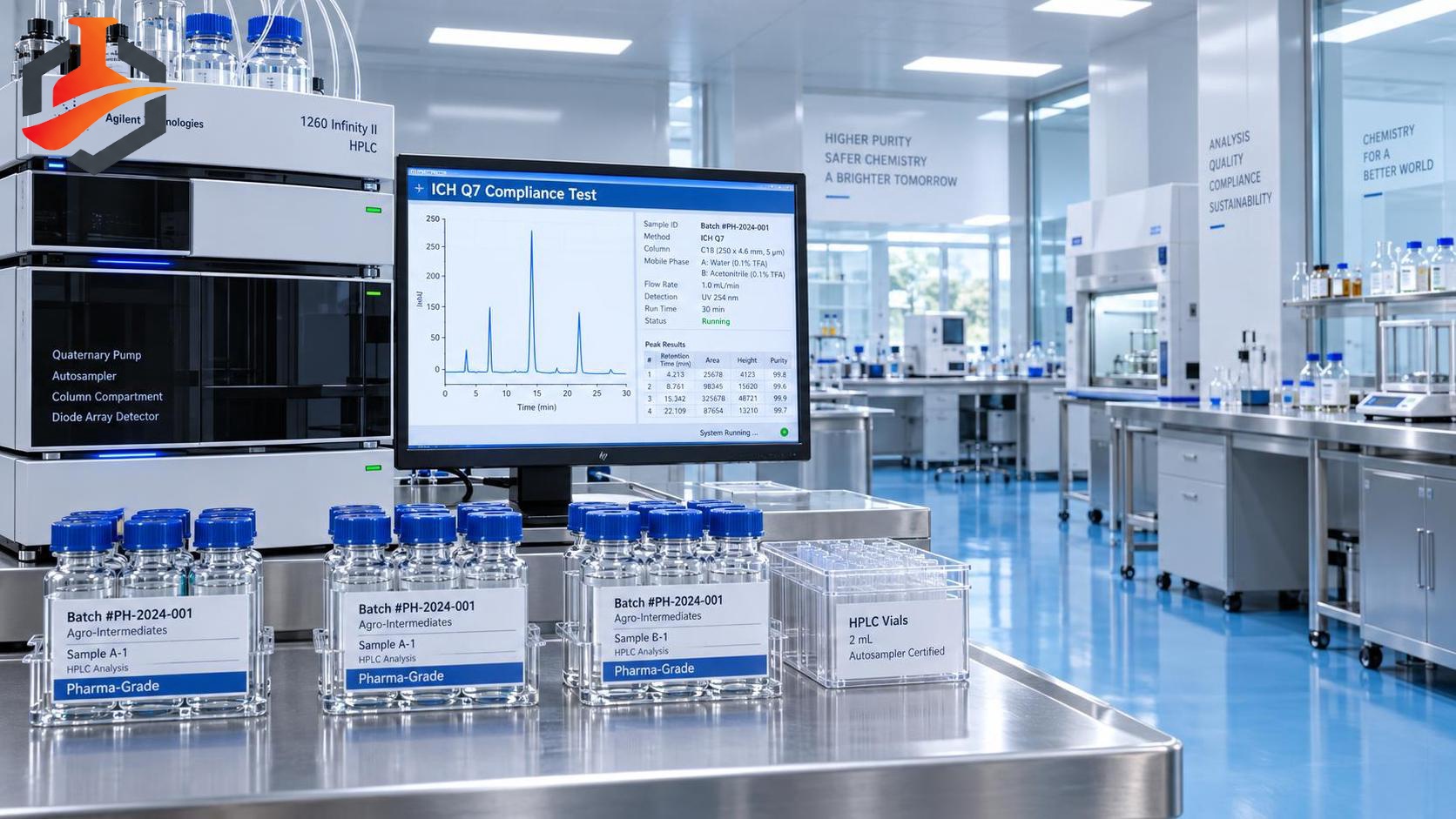
Here’s where real-world habits diverge. In pharma, consistency testing isn’t just about assay and related substances. It includes chiral purity (if relevant), residual solvents (per ICH Q3C), elemental impurities (Q3D), and often particle size distribution—especially if the intermediate participates in a crystallization-driven step. Why? Because a 5% shift in particle size can change filtration rate by 40%, or introduce seeding variability that impacts polymorph control downstream.
Agrochemical manufacturers often focus on assay, key impurities, and moisture—enough to ensure formulation stability and field efficacy. But we’ve seen cases where inconsistent trace metal content in a catalyst-derived intermediate caused batch-to-batch variation in emulsification behavior—leading to nozzle clogging in spray equipment. That wasn’t caught until field trials. So while the spec sheet said “pass,” the functional performance didn’t.
ICH Q7: Not a Checklist—A Mindset (and Yes, It Applies Beyond APIs)
ICH Q7 isn’t optional for pharma intermediates—it’s foundational. But here’s what experienced QC managers quietly agree on: applying Q7 *selectively* (e.g., only to steps after the penultimate reaction) is increasingly risky. Regulators now routinely ask for justification of the “Q7 boundary.” If your process contains a genotoxic reagent at Step 3, and you claim Q7 starts at Step 5, be ready to show mass balance data proving complete removal—or accept that Step 3 falls under Q7 scope.
For agrochemical suppliers, Q7 isn’t mandated—but its logic is contagious. Consider this: an audit by a major crop protection company recently flagged inadequate change control for a raw material substitution in a non-GMP intermediate. Their rationale? “If this change affects degradation profile in the formulated product, it affects environmental fate data—and that’s part of our registration dossier.” That’s Q7 thinking, applied sideways.
A Practical ICH Q7 Compliance Reality Check
Don’t treat Q7 as a document stack. Treat it as a set of decision filters. Below are the five checkpoints that actually stop problems—not the ones you tick off before lunch:
- Does your batch record capture the “why” behind critical process parameters? Not just “stirring speed = 60 rpm,” but “60 rpm prevents localized overheating that forms Impurity X.”
- Are deviations investigated beyond “out-of-spec”? A result within spec but trending upward? That’s a deviation under Q7 Principle 5—even if no spec was breached.
- Is your cleaning validation scoped to residues that matter—not just the last API? If your reactor also runs a nitrosamine-prone chemistry, residual nitrite matters more than residual acetone.
- Do you retain samples long enough to support stability claims—not just regulatory minimums? For intermediates used in multi-year API campaigns, 2 years may be insufficient if the API shelf life is 36 months.
- Can you reconstruct the full material genealogy—from starting material COA to final intermediate certificate—in under 2 hours? If not, your traceability system is theoretical, not operational.
The Grey Zone: Where “Good Enough” Becomes a Liability
There’s a quiet tension around intermediates used in both sectors—like certain heterocyclic building blocks or chiral auxiliaries. Some suppliers run dual-track manufacturing: one line under full Q7, another under ISO 9001. That works—until a customer switches use cases mid-contract. We’ve seen intermediates originally released for agrochemical use get diverted to pharma R&D. When the impurity profile didn’t meet Q3A, the supplier had no recourse—no retest protocol, no justification package, no audit trail for the analytical method transfer. The fix wasn’t retesting. It was rebuilding documentation retroactively—a week-long effort that delayed a clinical trial batch.
So ask yourself: does your QC system assume *intended use*—or prepare for *actual use*? Because in today’s supply chains, those aren’t always the same.
What to Do Next (Not “What to Read Next”)
Start with your three highest-volume intermediates. Pull the last three batch records. Ask: Could someone outside your team—say, a regulator or a new hire—reconstruct why each test was performed, why the acceptance criteria were set there, and what would happen if one parameter drifted 10%? If the answer isn’t immediate and evidence-based, that’s your priority—not updating the SOP template.
And one last thing: never let “not pharma” become shorthand for “low risk.” The most expensive recalls we’ve seen weren’t from API plants—they were from intermediates that failed in-field stability tests because trace oxidation products weren’t monitored. Oxidation wasn’t in the spec. But it was in the molecule.
- Last One:Ferroalloys Procurement Guide: How Manganese vs. Silicon vs. Chromium Ferroalloys Impact Steel Strength, Cost, and Slag Formation in EAF OperationsSep 14, 2026
- Next Article:Industrial Chemical Raw Materials Sourcing Trends in 2024: Supply Chain Localization, Green Feedstock Shifts, and Price Volatility Mitigation StrategiesSep 14, 2026